
By Verónica García, Newtral
Organised by Fondazione Bruno Kessler (FBK) in Trento, Italy, the final events of the HYBRIDS project will bring together leading researchers, AI experts, industry professionals, policymakers, journalists, and social stakeholders to discuss the growing impact of disinformation, online polarization, hate speech, and generative AI on democratic societies.
From 22 to 25 June, Trento will host the final conference and showcase of the HYBRIDS project, a Horizon Europe Marie Skłodowska-Curie Doctoral Network dedicated to understanding and addressing disinformation, online manipulation, hate speech, and other challenges affecting digital public discourse through Artificial Intelligence and advanced language technologies.
Over the past four years, HYBRIDS has trained a new generation of researchers while developing innovative datasets, AI models, software tools, and scientific methodologies to better understand how information spreads online, how narratives shape public opinion, and how emerging technologies can help build more resilient democratic societies. The final events, hosted by FBK, will provide an opportunity to present these results and discuss their societal impact with researchers, practitioners, and stakeholders from across Europe.
Navigating disinformation in the age of Artificial Intelligence
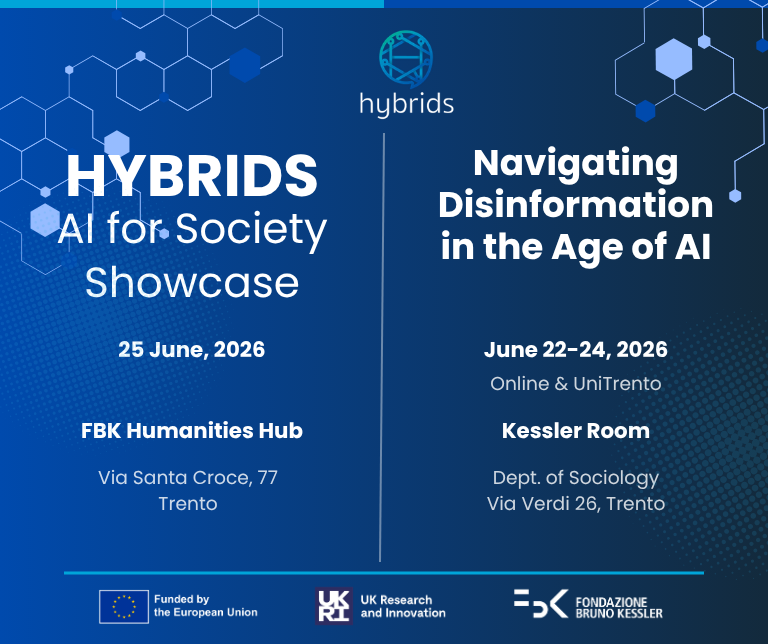
Over three days, from June 22nd to 24th, the final conference, titled Navigating Disinformation in the Age of AI, will take place both online and at the Kessler room of the Department of Sociology at the University of Trento (UNITRENTO). The event will showcase the main scientific achievements of the HYBRIDS project and provide a forum for discussing some of the most pressing challenges facing democratic societies in the digital era.
The comprehensive program will feature keynote talks from internationally recognized experts and presentations from HYBRIDS doctoral candidates and partners. Discussions will delve into the societal and democratic implications of AI technologies, covering critical topics such as misinformation detection, argument mining, fact-checking, hyperpartisan discourse, and the impact of Large Language Models (LLMs) and multimodal AI.
Interactive AI for society showcase
Co-located with the final conference, the HYBRIDS AI for Society Showcase will be held on June 25th at the FBK Humanities Hub. This highly interactive session is designed to foster a direct dialogue between academia, industry, and society.
Participants will have the unique opportunity to explore live demonstrations of HYBRIDS case studies, showcasing how AI-driven tools analyze and detect different disinformation phenomena using real-world data. The session aims to collect direct feedback from stakeholders on the relevance, usability, and societal impact of the project’s technological outcomes.
As the project aims to bridge the gap between academic research and the public, these events are highly recommended for researchers, journalists, policymakers, NGOs, technology developers, and anyone interested in digital communication.
Registration Open
Registration for both events is now open until Wednesday, June 17.
Participants can register for:
- Navigating Disinformation in the Age of AI (22–24 June)
- HYBRIDS AI for Society Showcase (25 June)
Researchers, journalists, policymakers, NGOs, technology developers, students, and anyone interested in AI, social media, and digital communication are encouraged to attend.
About the HYBRIDS project
HYBRIDS is a European Doctoral Network funded by the European Union through the Horizon Europe Marie Skłodowska-Curie Actions (MSCA) and co-funded by UK Research and Innovation (UKRI).
Coordinated by the Research Centre on Intelligent Technologies of the University of Santiago de Compostela (CiTIUS, USC), it involves partner universities, leading research centres, non-profit organisations, and innovation companies across Europe: Université de Caen (France), Universidade da Coruña (Spain), Universidade de Évora (Portugal), Radboud Universiteit (the Netherlands), Queen Mary University of London (UK), University of Padova (Italy), Consejo Superior de Investigaciones Científicas (Spain), Fondazione Bruno Kessler (Italy), GESIS-Leibniz-Institut für Sozialwissenschaften (Germany), Fondazione Openpolis ETS (Italy), Fundación Universidad Empresa Gallega (Spain), Factoría de software e multimedia S.L. (Spain), Industrieanlagen Betriebsgesellschaft MBH (Germany), and Newtral (Spain).
The project investigates how Artificial Intelligence can be used to understand, analyse, and counter disinformation, online manipulation, hate speech, and other forms of harmful digital communication. By combining expertise from computer science, social sciences, linguistics, communication studies, and data science, HYBRIDS develops innovative methodologies and technologies to strengthen democratic resilience in the digital age.