
By Verónica García, Newtral
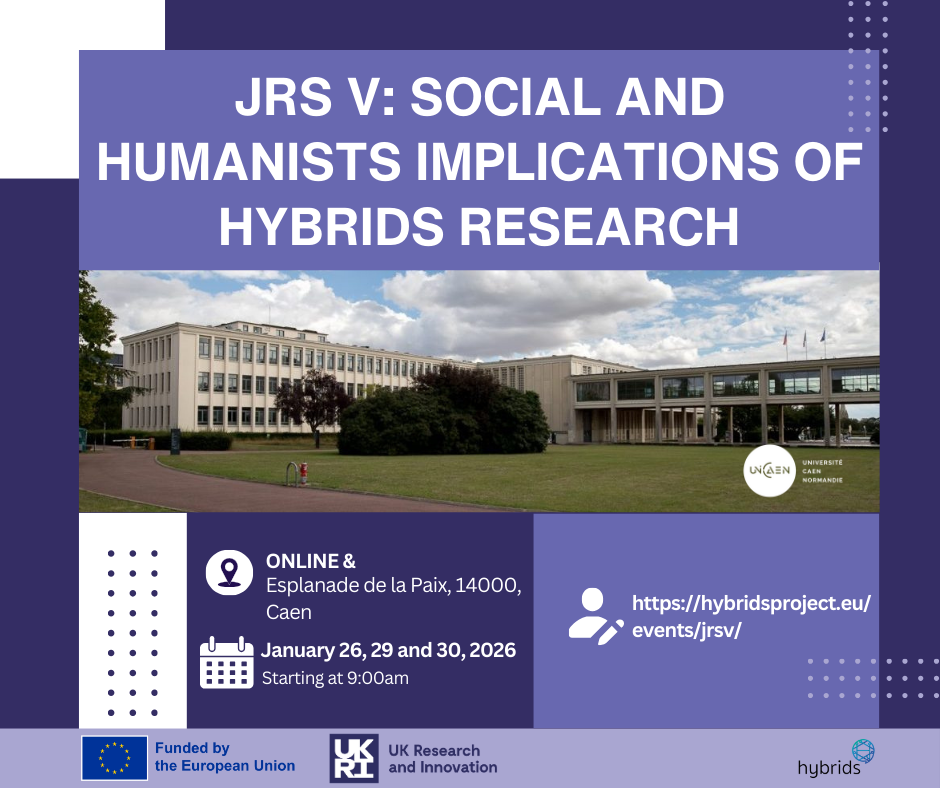
The University of Caen Normandy is set to host the fifth Joint Research Seminar (JRSV) of the HYBRIDS project that will take place from January 26 to 30, 2026.
This week-long intensive program brings together leading researchers, doctoral candidates, and industry partners from across Europe to explore the social, humanistic, and ethical implications of its investigations on disinformation, hate speech, and harmful online content
A week of cutting-edge research and collaboration
Experts from the University of Caen, Normandy, will focus on critical perspectives from the humanities and social sciences, addressing topics such as how artificial intelligence (AI) is reshaping reality worldwide or how hybrid threats have evolved into cognitive warfare.
In a constructive approach to technology, these public sessions, which will take place on January 26th, will also focus on tools to develop critical thinking skills and on the use of AI technologies to combat disinformation.
From political discourse and harmful content analysis to fact-checking and claim detection, on January 29th researchers from Spain, The Netherlands, Italy, England, Portugal and Germany will present workshops on combating disinformation with human and artificial intelligence.
The final day sessions, on January 30th, will connect attendees with industry experts on information verification and regulatory approaches to hate speech. Master’s and PhD students will also present their latest findings in computer science and human factors related to AI and democracy.
As the project aims to bridge the gap between academic research and the public, these three days will be open to researchers, students, and the wider public.
Registration for the event is free, and attendees may participate either in person or online.The full program can be found here.
Furthermore, the Tuesday and Wednesday sessions, which will not be public, will include a hackathon and practical sessions for the students.
Why Hybrid Intelligence?
In an era where large language models (LLMs) can both identify and inadvertently spread misinformation, the HYBRIDS project argues that technology alone is insufficient.
By incorporating linguistic, psychological, and sociological frameworks into AI development, the project develops “interpretable” models, ensuring that the tools used by journalists, fact-checkers, and policymakers are transparent and reliable.
About the HYBRIDS Project
HYBRIDS is the result of an international consortium led from Santiago de Compostela (Spain) by the Research Centre on Intelligent Technologies (CiTIUS). It includes 15 members (eight beneficiaries and seven partners) from seven European countries: France, Germany, Italy, Portugal, Spain, the Netherlands, and the United Kingdom. The participating institutions include seven universities, three R&D centers, two non-profit foundations, and three private companies.
The HYBRIDS Doctoral Network is funded by the European Union through the Horizon Europe Marie Skłodowska-Curie Actions (HE MSCA) and co-funded by UK Research and Innovation (UKRI) through the HE funding guarantee.