
By Showny Azar, Newtral
Before Siddharth Bhargava had ever heard of HYBRIDS, he was already captivated by a very specific question: how can the structure of human reasoning — the logic behind an argument, not just its words — be captured and modelled by a machine? As a research student working on argument mining, he found himself drawn equally to the philosophy of how humans reason and the psychology of why they reason the way they do. “Bringing artificial intelligence and NLP to automate the same is what sparked my interest,” he says.
Siddharth, now 28 and originally from Trento, hadn’t planned to start a PhD right after his Master’s — he wanted practical, hands-on experience first. He was in the middle of a job search when a networking group, Munich NLP, posted about an open position in HYBRIDS. “I curiously checked it out, I saw that it had a topic that focused on argument mining, and I was sold,” he recalls. The move from application to relocating to Trento happened fast — fast enough that he admits to wondering, early on, whether it had been the right call. “Now, after three years, I am happy,” he says.
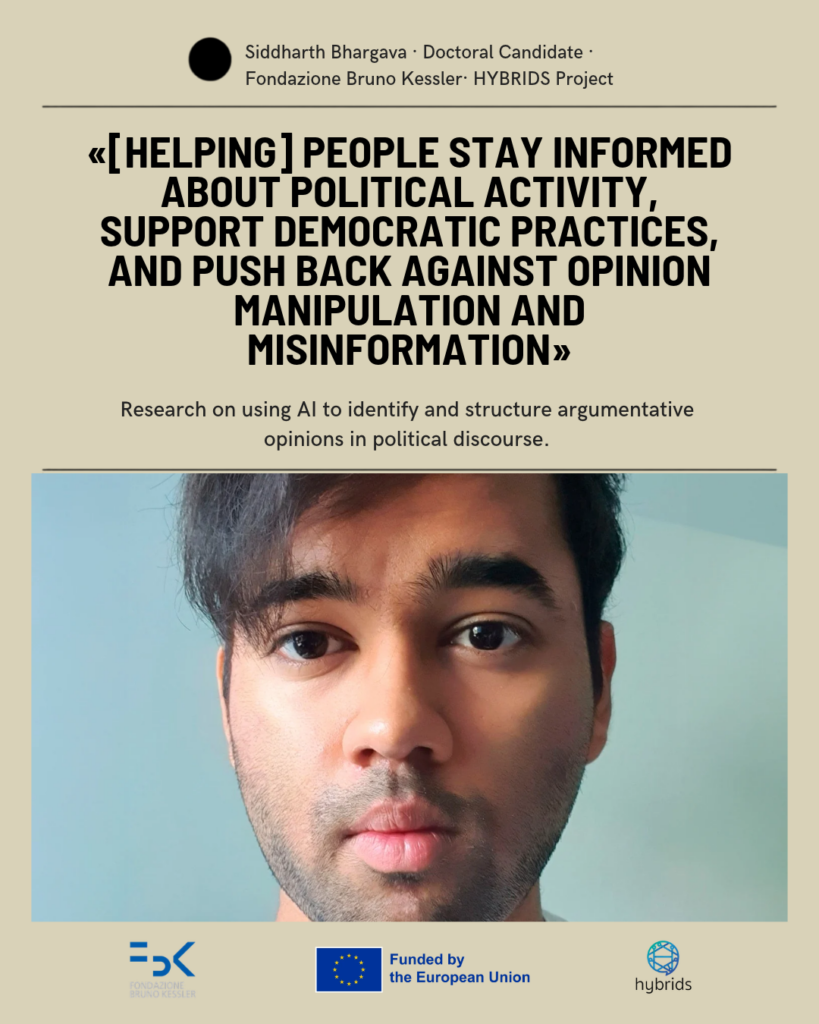
That decision brought him into HYBRIDS as Doctoral Candidate 3, hosted at Fondazione Bruno Kessler (FBK), where his doctoral research focuses on identifying the stance of argumentative opinions in political discourse.
What his research is about
Siddharth’s thesis tackles a problem anyone who has ever tried to follow a heated online debate will recognise: long political discussions are hard to navigate, and it’s not always clear which opinions are actually central to the argument, or how they support or contradict one another. “We built a decision-support system that helps users navigate long social discussions on political issues by building argument structures — graphs — out of them, that indicate what are the central opinions being presented by the participants, and how these opinions support or attack one another,” he explains. The aim is to test whether AI and argument mining can reliably help people stay informed about political activity, support democratic practices, and push back against opinion manipulation and misinformation.
To do this, his team developed what he describes as a novel neuro-symbolic framework — one that merges natural and formal argumentation to parse complex, multi-party discussions, build large-scale argument structures out of them, and extract insights through symbolic reasoning.
What he found
The result is a system — Siddharth and his team call it POLIBRA — built around three capabilities. It performs what he calls “structured analytics,” turning long, free-flowing discussions into machine-readable argument networks that support reasoning and knowledge discovery. It keeps a human in the loop, through a modular architecture with version control, visual tracking, logging and the ability to inspect intermediate outputs. And it’s built to scale across different contexts, adapting to diverse argumentation schemas and custom reasoning frameworks.
What stood out most, even to Siddharth, was how the system held up under pressure. “Unlike standard LLMs that struggle with long-form context and hallucinate, our system guarantees strict logical grounding across complex discussions to deliver fully transparent, traceable, and reproducible outputs,” he says. “The reliability of our system on really long-form discussions surprised us.”
Why it matters
Siddharth sees several directions where this kind of structured, transparent reasoning can have real impact: industrial applications in decision-making, recommendation systems, explainable AI and automated summarisation; societal benefits through greater transparency, public engagement and democratic deliberation; and support for political and social science research into discourse analysis, persuasiveness and political strategy.
The practical use cases are concrete. Digital platforms could use POLIBRA to parse active discussions into traceable, explainable summaries. Citizens could use it to engage more meaningfully and transparently with political debate. And journalists could use it to process large volumes of discourse through a structured, deterministic model that follows clear logical and symbolic rules rather than opaque, probabilistic judgment calls.
At the core of his contribution to fighting disinformation is a specific insight: argumentation mining grounds its analysis in logic and reasoning while also accounting for human sentiment, intent and goals. POLIBRA takes advantage of exactly that combination, analysing long-form, noisy online discourse to produce structures that are traceable and transparent by design — a particular strength, Siddharth notes, in settings “where information is missing, context-dependent, and dispersed.” He also sees a policy dimension to this work: by identifying the key arguments for and against a position within a long discussion, systems like his could help policymakers develop responses that actually address the substance of public debate, rather than its loudest fragments.
Life inside a European doctoral network
Being part of HYBRIDS, Siddharth says, changed him both professionally and personally. At FBK, he found an environment with everything he needed to carry out his research, and the chance to meet experts across different fields who helped shape the direction of his work.
What’s next
Siddharth is candid about the open questions his thesis leaves behind. The first is a limitation he sees clearly: his system evaluates arguments mainly by their content and structure, giving less weight to who is making the argument or the emotion behind it — even though, in real political argumentation, the source and the audience matter a great deal to how an argument lands. This “remains an open problem,” he says. The second is more technical: the symbolic component of his framework doesn’t generalise well across contexts, something he flags as an open challenge for whoever picks this line of research up next.
As for his own path, Siddharth has arrived at a clear sense of what he wants to do next. “I have realised I am more of an engineer than a researcher,” he says, “and I would like to work in areas that are more practical-oriented than theoretical.” If he stays in academia, he wants to keep working on neuro-symbolic frameworks and reasoning models — but he says it’s more likely he’ll move into industry, as an AI specialist or a forward-deployed engineer.
His advice for anyone considering a career in this field is practical, almost like a project plan: “First, understand the current limitations or bottlenecks of the state of the art. Identify your data sources, and of those, which ones could be accessed legally. Use the first year to explore, the second year to try some experiments and design your methodology, and the third year to actually implement it.”