
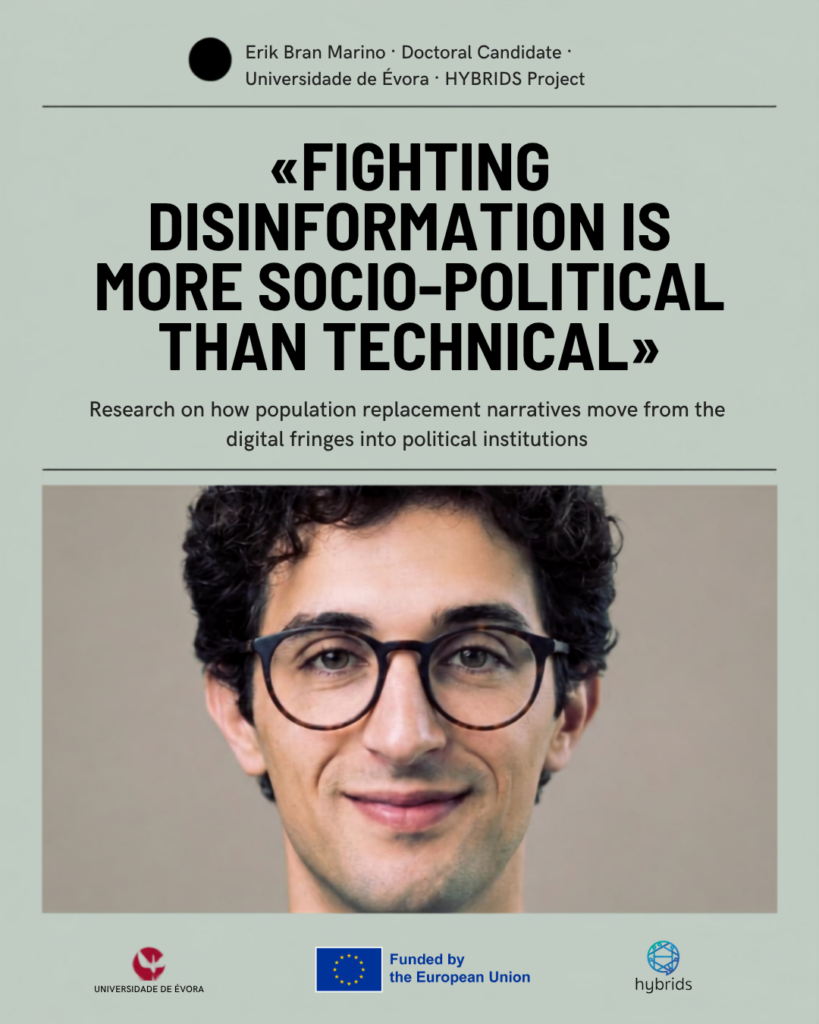
By Showny Azar, Newtral
Erik Bran Marino grew up in Turin with posters of the European Union on his bedroom wall, tracking its enlargement from six countries to twenty-five. “I grew up considering the EU as my home,” he says. In 2016, Brexit shattered that certainty — and left him with a question he couldn’t shake: what makes fake news, post-truths and conspiracy theories powerful enough to move an entire country’s vote?
Erik, now 28, would spend the next years turning that question into a research career. The final push came in 2022, when Russia’s invasion of Ukraine drew his attention to how Russian narratives were shaping Western public opinion. That led him to teach himself Python to study disinformation networks on Telegram. He finished his Master’s in Sociology in March 2023, and a month later applied for an MSCA position that seemed “perfectly aligned” with his interests at the intersection of computer science and disinformation. “I was also lucky,” he adds.
That application brought him into HYBRIDS as a Doctoral Candidate, based at the University of Évora, where his doctoral research investigates the political propagation of disinformation campaigns on social networks.
What his research is about
Erik focuses on what he calls Population Replacement Conspiracy Theories (PRCT) — the narrative claiming that migrants are being brought in to “replace” native populations. Scientific research has repeatedly shown these narratives to be false, but Erik’s interest is not in refuting them; it’s in understanding how they move from the margins into the mainstream. He traces their evolution in Italy and Portugal from the 1990s — when the fall of the Soviet Union removed communism as the era’s central “threat” narrative — up to today, when migrants have taken its place in the eyes of many.
To study this at scale, Erik turned to natural language processing. “I use AI (NLP) techniques to study huge amounts of text that it would be impossible for a human to process,” he explains — parliamentary records, Telegram channels, news coverage, political manifestos and web pages, spanning three decades and two countries.
What he found
The results challenge a common assumption: that PRCT spreads into institutions simply because demographic change creates fertile ground for it.
“Demographic pressure alone does not predict institutional PRCT penetration,” Erik explains, “as structurally identical demographic shifts produced a parliamentary null in Portugal but established institutionalization in Italy. Institutional configurations — normative frameworks, media gatekeeping, and political opportunity structures — determine whether replacement narratives are contained in digital fringes or not.”
In other words: it isn’t the presence of migration that decides whether a conspiracy theory takes hold in a country’s politics. It’s whether a country’s institutions and media let it through the door.
One result surprised even him. “PRCT concentration in Italy is actually higher in Parliament (0.60%) than on Telegram (0.37%) — a complete reversal of conventional wisdom,” he says, though he’s careful to add the caveat that this is tied to the specific data available to him, rather than a universal rule. Still, it’s a striking reminder that the “fringe” and the “mainstream” don’t always behave the way we assume.
Why it matters
For Erik, the point of this research isn’t to build another tool that flags and deletes disinformation. “This thesis treats disinformation as a symptom of deeper social and political problems,” he says. “It uses language models to diagnose how real-world institutions and media systems either block or help spread toxic narratives into the mainstream.” The goal is to show that the mainstreaming of replacement conspiracies — a narrative that has delivered real electoral gains to far-right actors — is not an inevitable consequence of demographic change, but the result of specific institutional and media choices.
That reframing has practical value for several audiences. Journalists and public institutions can use his findings to avoid inadvertently amplifying covert replacement narratives, to recognise how radical rhetoric disguises itself in sanitised policy language — what Erik calls “rhetorical maquillage” — and to build stronger gatekeeping practices. Digital platforms and citizens, meanwhile, can benefit from the AI models he has developed over the course of his PhD.
His work has also fed into ongoing EU policy conversations: in January 2026, Erik contributed input to a proposal submitted to DG CONNECT, arguing that AI detection models alone are not enough while European communication continues to depend heavily on foreign platforms — insights on infrastructure resilience and open governance that speak directly to current debates around the EU’s Tech Sovereignty Package and Open-Source Strategy.
Three years inside a European doctoral network
Being part of a multidisciplinary, international doctoral network like HYBRIDS, Erik says, has been “beautiful, stimulating, but very tough as well.” Multidisciplinarity is exactly what a problem like disinformation demands — but he found that institutions aren’t always built to reward it. “After my PhD it’s very hard to find a job in multidisciplinary research,” he notes, “as many of the positions are open for a highly specialised profile in a very specific niche.”
There’s also a more personal reflection he wanted to share — one he says is shared by many of his fellow doctoral candidates: the sense that projects like HYBRIDS, working carefully and rigorously against disinformation, sometimes feel outnumbered by actors moving in a very different direction, with considerably more resources behind them. It’s not a comfortable thing to say, but it’s an honest one — and it shapes how seriously he takes the work.
What has made the three years worth it, he says, are the people. “I feel privileged for having lived such an adventure,” Erik reflects. “Tough but very stimulating at the same time. After these three years I have made some — hopefully — life-bonding friendships.”
What’s next
Erik’s thesis leaves open questions he hopes future research will pick up: whether the computational and psycholinguistic frameworks he built travel beyond Southern Europe to non-Western contexts and encrypted platforms, and how NLP methods might be extended to model structural socio-economic grievances alongside textual discourse.
For himself, three years of research have led him to a conclusion that goes beyond his own models: “The solution to ‘fight’ disinformation is more socio-political than technical. We need NLP to help flag disinformative content, but these are just the symptoms of economic precarity and inequality, informational inequality and stratified access.” It’s a conclusion that points him toward international policy work — he says he’d love to continue this path at international organisations in Geneva.
His advice to anyone considering a career researching disinformation or AI applied to democracy is equal parts encouragement and warning: “It’s a very stimulating field, and you have concretely the feeling you are helping society, using AI in a proper and not-sloping way. But be aware: as Nietzsche said, if you gaze long into an abyss, the abyss also gazes into you.”