
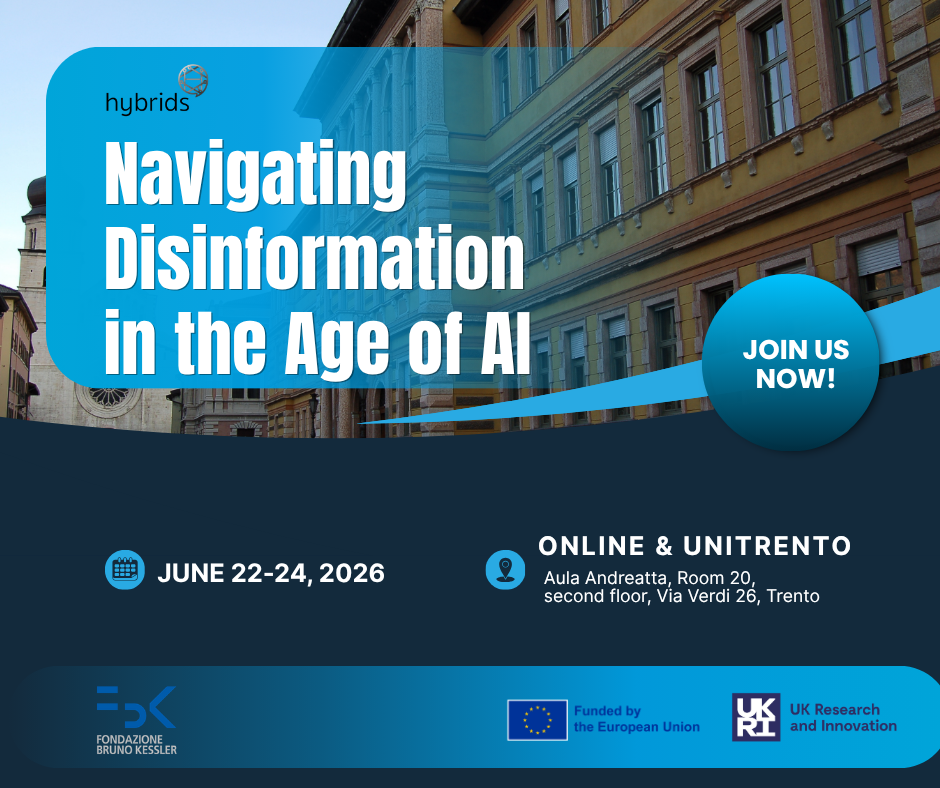
Navigating Disinformation in the Age of AI
📍 Location
ONLINE & UNITRENTO
Aula Andreatta, Room 20, second floor,
Via Verdi 26, Trento, Italy
🌍 About the Event
Navigating Disinformation in the Age of AI is the final conference of the HYBRIDS project, bringing together researchers, AI experts, industry professionals, and social stakeholders to discuss the challenges posed by disinformation, online polarization, hate speech, and AI-generated content in today’s digital society.
Over three days, the conference will showcase the main scientific results of the HYBRIDS project and related research initiatives, covering topics such as misinformation detection, argument mining, fact-checking, hyperpartisan discourse, multimodal AI, Large Language Models (LLMs), and online harms.
The programme features keynote talks from internationally recognised experts, presentations from HYBRIDS doctoral candidates and partners, and discussions on the societal and democratic implications of AI technologies.
🎯 Objectives
- Showcase the main scientific results and datasets developed within the HYBRIDS project
- Foster interdisciplinary dialogue on AI, disinformation, and digital society
- Explore the societal impact of generative AI and online information disorders
- Discuss emerging challenges related to hate speech, propaganda, polarization, and fact-checking
- Strengthen collaboration between academia, industry, policy stakeholders, and civil society
👥 Who Should Attend
- Researchers and academics
- AI and NLP practitioners
- Journalists and media professionals
- Policy makers and public institutions
- Social organisations and NGOs
- Industry stakeholders and technology developers
- Students and early-career researchers
- Anyone interested in AI, misinformation, and digital communication
💡 What to Expect
- Keynote talks from leading international experts
- Research presentations on AI and disinformation
- Discussions on online harms, digital manipulation, and democratic resilience
- Insights into multilingual and multimodal misinformation detection
- Networking opportunities with researchers and stakeholders working at the intersection of AI and society
📣 Why Attend?
Discover how cutting-edge AI and NLP research is helping society better understand online manipulation, misinformation, hate speech, and digital polarization — and engage with experts shaping the future of trustworthy and socially responsible AI.
Hourly Schedule
Monday, 22 June 2026
- 9:00 - 9:30
- REGISTRATION
- 9:30 - 10:00
- Welcome: presentation of the HYBRIDS network and logistics
- 10:00 - 10:50
- Keynote 1: When do arguments become propaganda? An NLP Lens on Political discourse
-
Speakers:
Serena Villata (INRIA/CNRS Sophia Antipolis)
- 10:50 - 11:30
- COFFEE BREAK
- 11:30 - 11:45
- Hybrid Methods for Detecting Extremist Narratives in Migration Discourse
-
Speakers:
Erik BRAN MARINO (University of Evora, Portugal)
- 11:45 - 12:00
- Assisted Counterspeech Writing at the Crossroads of Hate Speech and Misinformation
-
Speakers:
Helena Bonaldi (FBK)
- 12:00 - 12:15
- EuroVerdict: A Multilingual Dataset for Verdict Generation Against Misinformation.
-
Speakers:
Stefano Menini (FBK)
- 12:15 - 12:30
- Analyzing Dataset Quality through the Lens of Language Model interpretability
-
Speakers:
Rabiraj BANDYOPADHYAY (Leibniz Institute for the Social Sciences, Germany)
- 12:30 - 12:45
- How Language Models Conflate Logical Validity with Plausibility: A Representational Analysis of Content Effects
-
Speakers:
Leonardo Bertolazzi (University of Trento)
- 12:45 - 13:00
- Text-level genericity in machine and human text
-
Speakers:
Søren FOMSGAARD (University of Caen Normandy)
- 13:00 - 14:30
- LUNCH
- 14:30 - 15:20
- Keynote 2: The Big V. Online gender-based violence in a changing technospace
-
Speakers:
Elena Pavan (University of Trento)
- 15:20 - 15:35
- Addressing Geographic Bias in Hate Speech Detection using Debias Tuning in Large Language Models
-
Speakers:
Paloma Piot Pérez (DC at UDC)
- 15:35 - 15:50
- Challenges in Synthetic Data to Detect Hate Speech
-
Speakers:
Camilla Casula (Fondazione Bruno Kessler), Paloma PIOT PEREZ ABADIN (University of La Coruña, Spain)
- 15:50 - 16:00
- Closing day 1
Tuesday, 23 June 2026
- 9:15 - 9:30
- Opening Day 2
- 9:30 - 10:20
- Keynote Day 2: Social influence and misinformation online
-
Speakers:
Alberto Acerbi (University of Trento)
- 10:20 - 11:00
- COFFEE BREAK
- 11:00 - 11:15
- Drawing digital lines: pattern analysis of divisive rhetoric in social network discussions
-
Speakers:
Davide BASSI (CiTIUS- University of Santiago de Compostela, Spain)
- 11:15 - 11:30
- To Click it or not to Click it: An Italian Dataset for Neutralising Clickbait Headlines.
-
Speakers:
Daniel Russo (FBK)
- 11:30 - 11:45
- Hyperpartisan news detection
-
Speakers:
Michele Joshua MAGGINI (University of Santiago de Compostela, Spain)
- 11:45 - 12:00
- Mapping the interaction between science and misinformation in COVID-19 tweets
-
Speakers:
Lucila G Alvarez-Zuzek (FBK)
- 12:00 - 12:15
- Multimodal fact-checking
-
Speakers:
Rafael FRADE (Newtral, Spain)
- 12:15 - 12:30
- Multilingual vs Crosslingual Retrieval of Fact-checked Claims.
-
Speakers:
Marco Rovera (FBK)
- 12:30 - 14:00
- LUNCH
- 14:00 - 14:15
- The Dangerous Effects of a Frustratingly Easy LLMs Jailbreak Attack
-
Speakers:
Marco Bombieri (University of Trento)
- 14:15 - 14:30
- You Don't Bring Me Flowers: Mitigating Unwanted Recommendations Through Conformal Risk Control
-
Speakers:
Giovanni De Toni (FBK)
- 14:30 - 14:45
- From Argument Mining to Reasoning: Structural Dynamics of Political Conversations
-
Speakers:
Siddharth BHARGAVA (Fondazione Bruno Kessler, Italy)
- 14:45 - 15:00
- A Resource for Implicit Argumentation Detection: Dataset and Findings
-
Speakers:
Martial PASTOR (Radboud University, The Netherlands)
- 15:00 - 15:15
- Detecting Winning Arguments with Large Language Models and Persuasion Strategies
-
Speakers:
Tiziano Labruna (FBK)
- 15:15 - 15:30
- Fine-grained Fallacy Detection with Human Label Variation.
-
Speakers:
Alan Ramponi (FBK)
- 15:30 - 15:40
- Closing day 2
Wednesday 24 June 2026
- 9:15 - 9:30
- Opening Day 3
-
Speakers:
Michela Milano (FBK DIGIS center)
- 9:30 - 10:00
- How to Win Friends and Influence Bots with Persuasion Techniques
-
Speakers:
Giovanni Da San Martino (University of Padova)
- 10:00 - 10:30
- Claim matching for automated fact-checking
-
Speakers:
Arkaitz Zubiaga (Queen Mary University of London)
- 10:30 - 11:00
- Beyond Benchmarks: What Emotion Mining in Historical Texts Reveals About LLMs
-
Speakers:
Patricia Martín (University of A Coruña and CSIC)
- 11:00 - 11:30
- COFFEE BREAK
- 11:30 - 11:45
- Multilingual Assessment of Stereotypes in Large Language Models
-
Speakers:
Beatrice Savoldi (FBK)
- 11:45 - 12:00
- Representations and instantiations of conspiracy theories
-
Speakers:
Katarina LAKEN (Fondazione Bruno Kessler, Italy)
- 12:00 - 12:15
- When Is It Hate? Rethinking Disagreement in Subjective NLP Tasks
-
Speakers:
Elisa Leonardelli (FBK)
- 12:15 - 12:30
- Closing








Date
- Jun 22 - 24 2026
- Expired!
More Info

Speakers
-
Serena Villata (INRIA/CNRS Sophia Antipolis)
-
Elena Pavan (University of Trento)
-
Alberto Acerbi (University of Trento)