
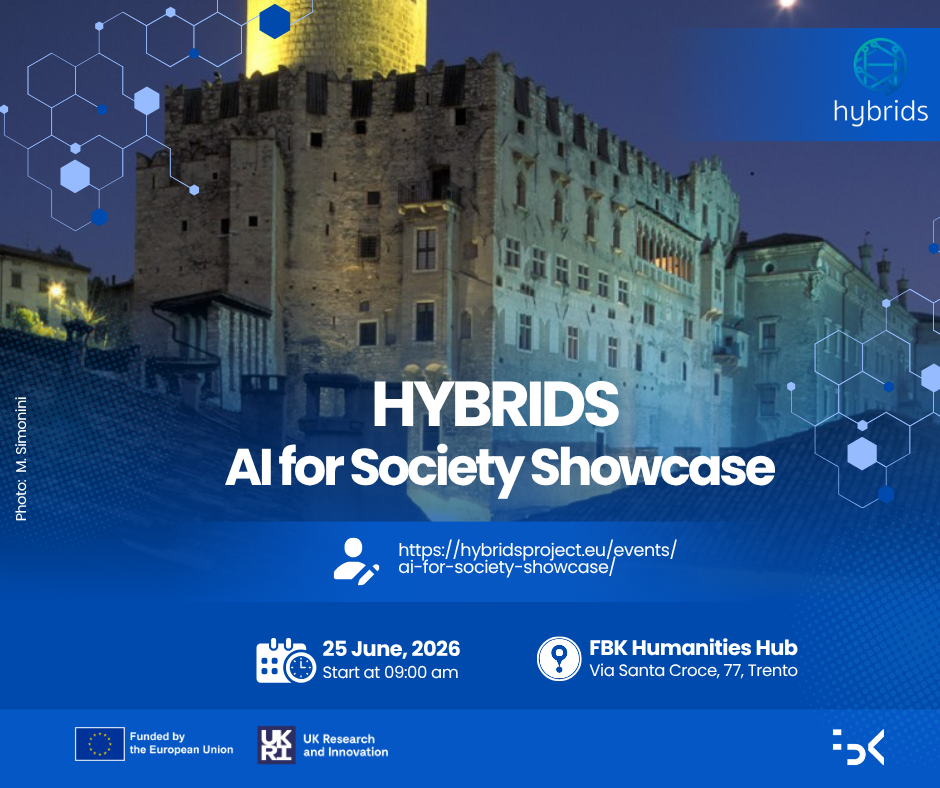
HYBRIDS AI for Society Showcase
📍 Location
FBK Humanities Hub
Via Santa Croce, 77
Trento, Italy
🌍 About the Event
The HYBRIDS AI for Society Showcase is a dissemination event co-located with the Final Conference of the HYBRIDS project.
This interactive session brings together researchers, industry professionals, social stakeholders, and the general public interested in tackling disinformation and understanding its societal impact.
Participants will have the opportunity to explore live demonstrations of HYBRIDS case studies, showcasing how AI-driven tools analyse and detect different disinformation phenomena using real-world data.
🎯 Objectives
- Showcase the main results and tools developed within the HYBRIDS project
- Demonstrate real-world applications of AI for analysing disinformation
- Foster dialogue between academia, industry, and society
- Collect direct feedback from stakeholders on the relevance, usability, and impact of the project outcomes
👥 Who Should Attend
- Researchers and academics
- Journalists and media professionals
- Policy makers and social organisations
- Industry stakeholders and tech developers
- Anyone interested in AI, social media, and disinformation
💡 What to Expect
- Live demos of AI tools and datasets
- Interactive discussions with researchers
- Networking opportunities with experts and stakeholders
- Insights into the societal impact of disinformation technologies
📝 Registration
👉 Register here: [link to be added]
📣 Why Attend?
Discover how cutting-edge AI solutions are being used to understand and combat disinformation, and contribute your perspective to shaping future research and applications.
Date
- Jun 25 2026
Speakers
-
 Erik BRAN MARINO (University of Evora, Portugal)
Erik Bran Marino is an Italian PhD researcher and Marie Skłodowska-Curie Fellow at the Universidade de Évora in Portugal, contributing to the HYBRIDS project. His work bridges natural language processing (NLP) and social sciences to detect political disinformation in online media. Erik earned his Master’s degree in Sociology and Social Research from the Università degli Studi di Torino, graduating with honors. His thesis investigated Russian manipulation of Western public opinion through conspiracy networks on Telegram. He has presented his research progress at international conferences such as APSA in Philadelphia and AECPA in Burgos. His publications cover topics like sentiment analysis in Portuguese political manifestos and the polarization loop on social media. Proficient in English, Italian, Spanish, French, and intermediate in Portuguese, Erik combines his passion for NLP and AI technologies with his social science background to advance interdisciplinary research.
-
 Davide BASSI (CiTIUS- University of Santiago de Compostela, Spain)
Davide has a background in discursive psychology and mediation. He is now working to assess the impact of political discourses on community interactions.
Davide studied Anthropology and Psychology at the University of Bologna. Then he moved to the University of Padova, where he obtained his master’s degree in Clinical Psychology and, after, a II level master’s degree in Mediation.
He worked as research fellow at the University of Padova, using computational social sciences to tackle community issues such as stigmatization, social cohesion and misinformation.
His research aims at using argumentation and rhetorical theories to assess and observe how political discourses impact on users’ interactions in social networks. Using these theoretical-methodological references, he will focus his analysis on the topics of “Euroscepticism” and “Immigration”.
-
 Martial PASTOR (Radboud University, The Netherlands)
Investigating rhetoric in new forms of textual mediums’.
Martial Pastor has background in Computer Science, Linguistics and Film Studies. He demonstrates a keen interest in using computational approaches to modelling various linguistic and cultural phenomena. He is particularly focused on the confrontation of NLP models with language diversity. Some of his previous projections include Corpus Linguistics investigations into speech dysfluencies, collaborations with psychiatrists to gain insights into the linguistic manifestations of pain, and database-driven research on language change, utilizing etymons sourced from over 50 different language families.
-
 Siddharth BHARGAVA (Fondazione Bruno Kessler, Italy)
With a demonstrated history of working in Data Science and AI, Siddharth is currently involved in discourse analysis and argumentation studies.
Having received his B.Tech in Computer Science at VIT Vellore India and M.Sc. in Data Science at LMU Munich Germany, Siddharth has worked as a research student during his Master’s program wherein he developed a deep passion for the fields of discourse analysis and argumentation. He actively participates in various tech and Artificial Intelligence events, looking for opportunities to connect and exchange ideas with people from around the world. If not caught solving data challenges, you can find him in the kitchen, fitness training, or travelling. Siddharth, as a MSCA fellow, hopes to become a strong voice for advocating open and fair data science practices, particularly in social sciences. His living philosophy is, “If you have the will, you will find the way.”
-
 Søren FOMSGAARD (University of Caen Normandy)
Coming from computational linguistics and philosophy technology, I am interested in how linguistic patterns or styles differ between humans and machines.
Textual online content generated and/or propagated by non-human agents has become an increasingly present phenomenon on social media platforms. When deployed with malicious intent, the behavior of this kind of agent can have impacts that are either directly harmful to people that are targeted by this behavior, for example, through toxic language use, or impacts that are more indirectly harmful, for example, by intervening in political discourse.
With the advent of contemporary large language models, the near future may feature more bots that employ increasingly sophisticated human-like harmful language online. Therefore, being able to detect linguistic patterns and idiosyncrasies will play a role in identifying harmful textual content that is not only spread but also generated by machines.
My research interests include authorship analysis, computational sociolinguistics, and the philosophical issue of what defines and differentiates human, non-human, and hybrid forms of agency. I joined the HYBRIDS project because of its focus on interdisciplinary research, interaction, and collaboration, both in its individual research tracks and at the network level.
-
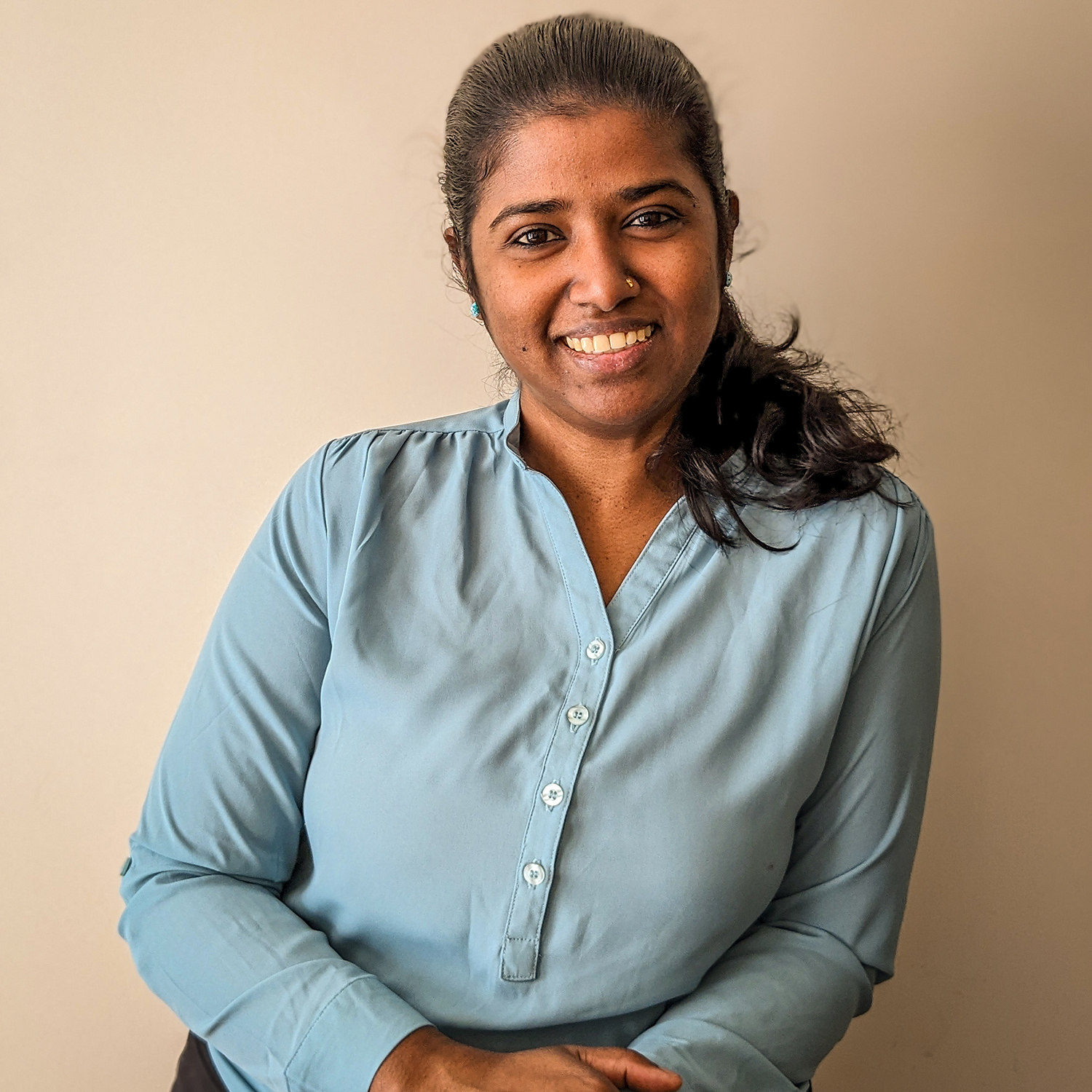 Rrubaa PANCHENDRARAJAN (Queen Mary University of London, England)
Bringing a wealth of experience in NLP, Rrubaa is presently engaged in an exciting project focused on cross-lingual claim detection.
As a passionate Natural Language Processing (NLP) researcher with over 7 years of experience, Rrubaa consistently seeks to address real-world NLP challenges. She attained her Bachelor’s in Computer Science and Engineering from the University of Moratuwa. Subsequently, she completed her Master’s in Computer Science at the National University of Singapore, an institution consistently ranked among the world’s top universities.
Throughout her professional trajectory, Rrubaa has worn various hats, including roles such as Software Engineer, Lecturer, and Research Associate in both industry and academia. This diverse experience has equipped her with a unique ability to bridge the gap between the academic realm and industry practices, allowing her to become a well-rounded professional.
Beyond her professional pursuits, Rrubaa is a cherished wife, daughter, and sister, loving to spend quality time with her family.
-
 Rafael FRADE (Newtral, Spain)
Phd candidate at Newtral researching automated fact-checking and multi-modal machine learning.
I am currently researching automated fact-checking, namely multi-modal claim matching. The objective is to develop models and mechanisms to help fight the spread of fake news. Some of the applications we’re planning to work on are euroscepticism, climate emergency and health.
I have a bachelor’s degree in Social Sciences and a master’s in Economics. Before joining Newtral, I have worked as a software developer and as research assistant in projects of applied econometrics and economic growth. I am open to collaborations in projects involving automated fact-checking, semantic similarity, machine reasoning, information retrieval, multi-modal ML, applications of LLMs and machine learning applied to social sciences in general. -
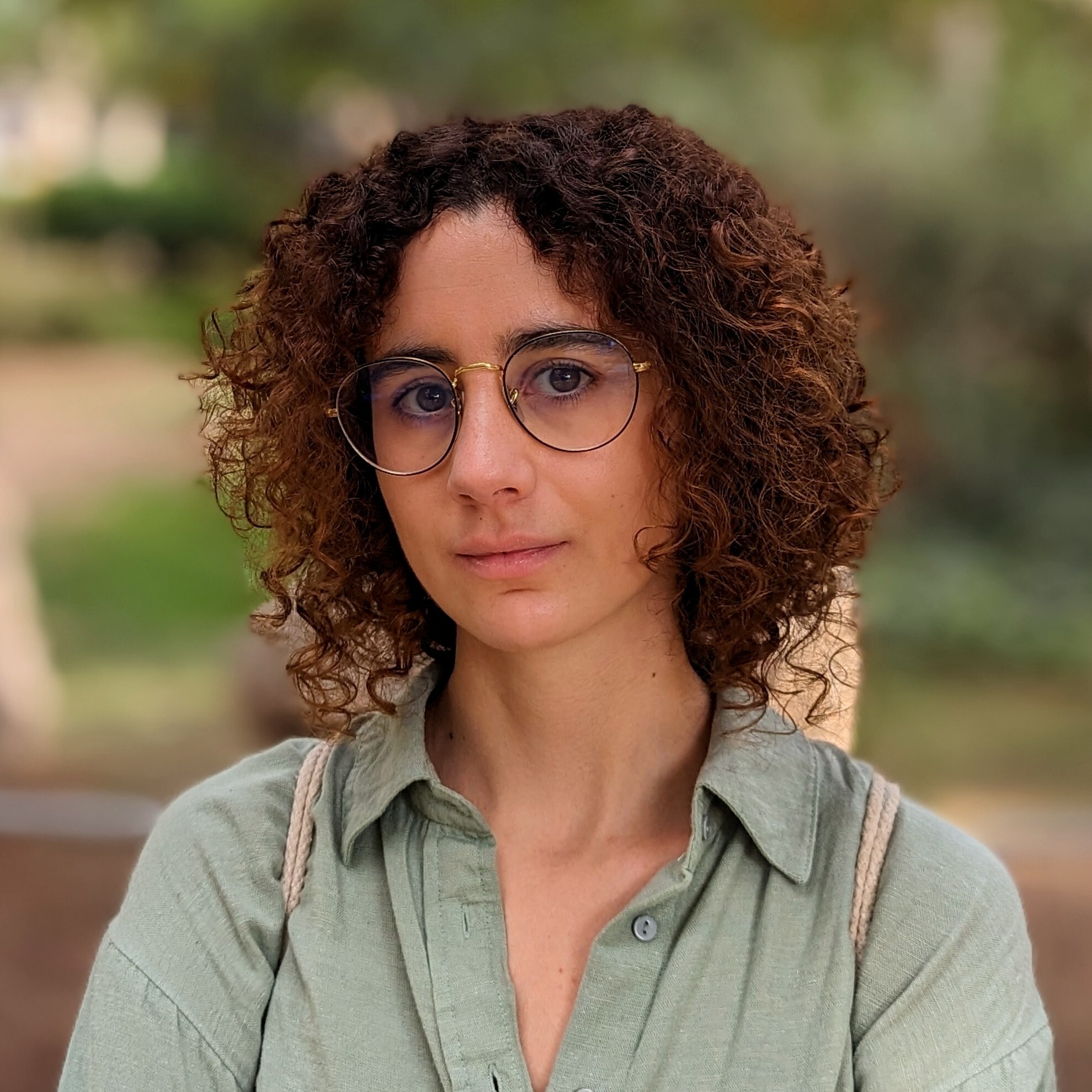 Paloma PIOT PEREZ ABADIN (University of La Coruña, Spain)
Paloma’s code breaks the chains of online hate, setting a new standard for digital discourse.
Paloma has a computer science background with experience in natural language processing models applied in social media addressing sensitive topics like detecting depression symptoms. She has industry experience working in different companies from different countries, advocates for women’s visibility in STEM, and likes participating in conferences and tech activities. She also enjoys listening to music and concert photography. -
 Michele Joshua MAGGINI (University of Santiago de Compostela, Spain)
Michele has a hybrid background in Humanities and Big Data. He has been working as a teacher and is now focusing on partisanship detection with DL.
Michele has been teaching Humanities for several years, cultivating an interest in the Philosophy of Science. Then, he graduated with an MSc in Big Data & Social Mining. He has increased his awareness of NLP, specifically in Social Network Analysis and LLM. His research is focused on developing systems for the automated detection of hyperpartisan news. -
 Rabiraj BANDYOPADHYAY (Leibniz Institute for the Social Sciences, Germany)
I want to use NLP to mitigate harmful content and make social media safe and inclusive for everyone.
I am passionate about leveraging NLP to help people and my PhD topic will deal with developing socially aware NLP systems that can help in mitigating harmful online content. I have experience in building NLP systems to solve various business problems, and using NLP and Deep Learning to model online user behavior in social networks (Twitter) and text repositories (Wikipedia) while pursuing my Masters from University at Buffalo (State University of New York)
-
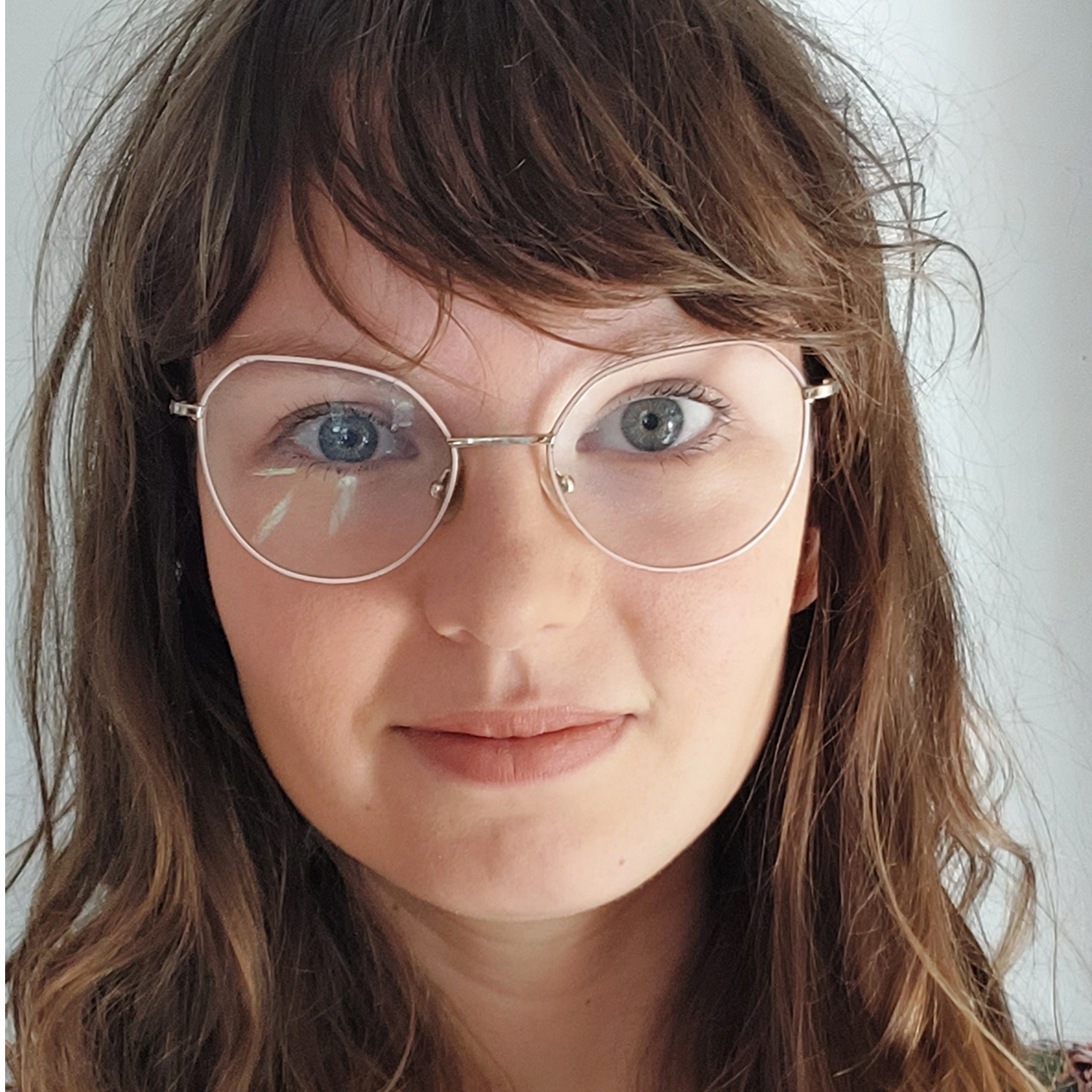 Katarina LAKEN (Fondazione Bruno Kessler, Italy)
I’m a passionate linguist who loves finding patterns in apparent chaos.
The thing I love most about language is the way it combines apparent chaos with a logical system of rules. During my bachelor’s and master’s in linguistics I specialized in language technology and NLP. This PhD position allows me to put these skills to good use combating hate speech and misinformation. In my free time I enjoy studying languages and hiking.